
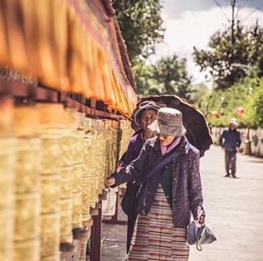
Xiazhulin Monastery
- Merry
- Last Updated : 03/06/2026
Xiazhulin Monastery (aka Shadrubling monastery) is located on Gongrigabu Mountain in Xue Village, Gonggar County, Shannan City, Tibet, at an elevation of approximately 3,200 meters. It lies about 15 kilometers from Lhasa Gonggar Airport. Backed by rolling mountains and facing the Yarlung Tsangpo River, the monastery stands quietly within the vast openness of the plateau.
The red and white walls are spread out layer by layer along the mountain, and the golden roof shines in the sun, contrasting with the meadows and snow-capped peaks, showing a typical and solemn Tibetan architectural pattern.
Xiazhulin Monastery is best known for enshrining a “thousand-year incorruptible body.” The figure is believed to be an emanation of Green Tara manifesting as Palden Lhamo. Seated in the posture of Tara, with one eye slightly open as if between wakefulness and meditation, the expression is serene, appearing not as one who has passed away, but as one absorbed in deep contemplation.
The following video offers a brief glimpse of Xiazhulin Monastery and its surroundings.
Historical Background
In Tibetan, the monastery is called “Shadrubling,” with its full name being “Ganden Shadrubling.” “Ganden” indicates its affiliation with the Gelug school of Tibetan Buddhism, while “Shadrubling” means “place for preaching and practice." Locals often refer to it as "Gongga Shadrubling.
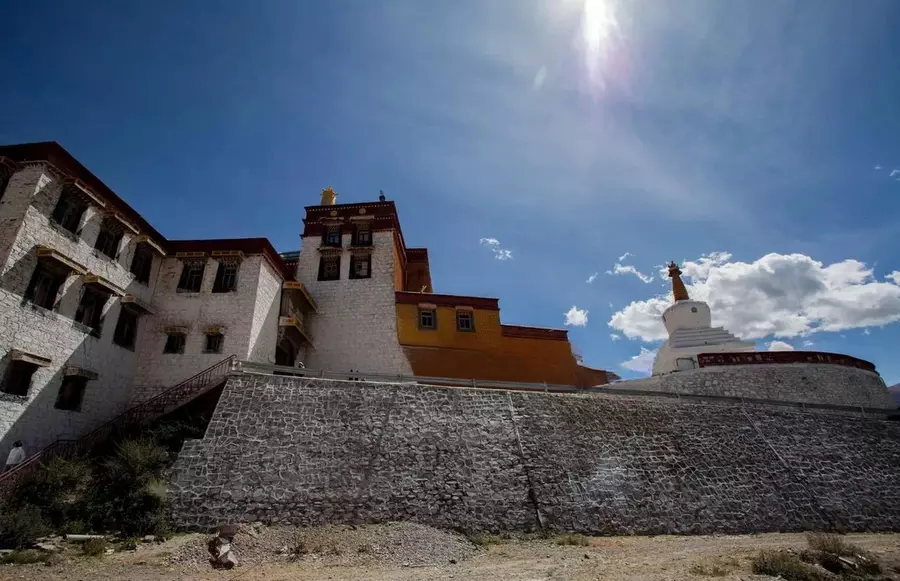
The monastery was originally founded in the 15th century under the guidance of Jamyang Master. In 1669, the Ninth Living Buddha, Karma Wangchuk Dorje, changed its religious affiliation from the Kagyu school to the Gelug school and formally established its present name, making it one of the important ancestral monasteries of the Gelug tradition in the region. During historical changes, the original monastery was destroyed. The current buildings were rebuilt in the 1980s under the supervision of the Sera Monastery's Khyentse Living Buddha.
The Shannan region is regarded as one of the cradles of Tibetan civilization. During the Tubo period, religious and political powers intertwined here, leaving a profound legacy. Gonggar, located in the middle reaches of the Yarlung River valley, was once an area frequented by the Tibetan aristocracy. Therefore, many monasteries and stupas can still be found in the surrounding area.
Monastic Structure and Enshrined Deities
Upon entering the monastery, the old and new buildings are interspersed, creating a distinct hierarchy.
To the left of the entrance stands the main assembly hall. On the first floor are statues of Tsongkhapa and his eight principal disciples, three master-and-disciple Buddha statues, and one-thousand statue of Tsongkhapa, along with statues of three Dharma kings from the Tubo period. The second floor houses the scripture library, where numerous Buddhist texts are carefully preserved.
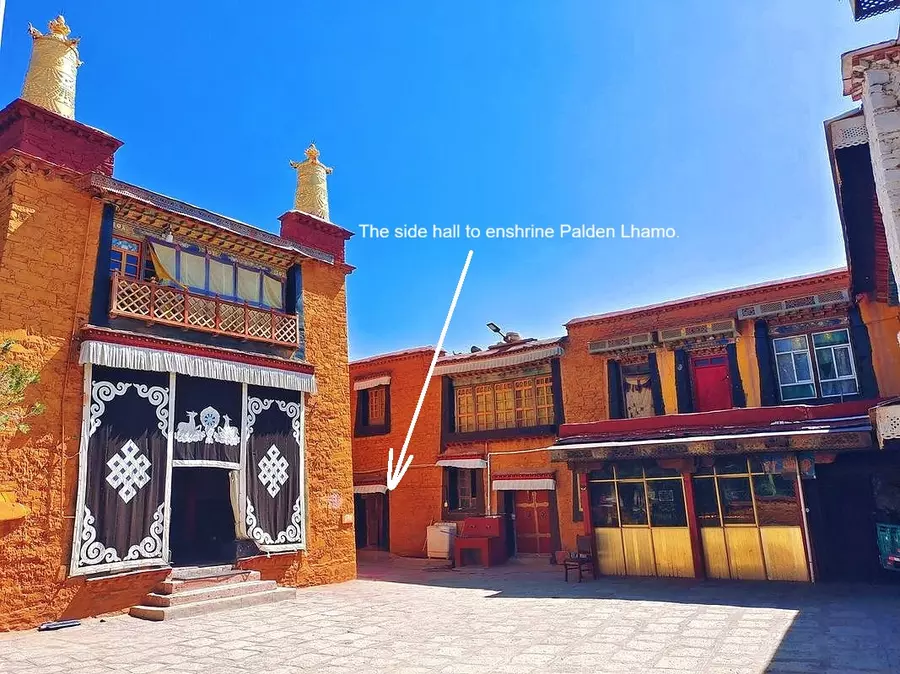
The famous corporeal statue of Palden Lhamo is housed in a side hall at the far end of the rear courtyard. The hall is dimly lit, creating a solemn and reverent atmosphere.
The adjacent protector deity hall enshrines the deity Shakyamuni, as well as protector deities such as Gelugpa Karma Trinley and Palden Lhamo. A female figure serving as an important protector deity is relatively uncommon in Tibetan Buddhist monasteries. The monastery also preserves exquisite murals and precious ancient scriptures, reflecting considerable religious and artistic value.
A Thousand-Year Legend
A story spanning more than a thousand years is associated with this preserved body.
Around 1045 CE, the Indian Buddhist master Atisha traveled to Tibet to spread the Dharma. While passing by a wide river, a young girl on the opposite bank saw the venerable master and was deeply moved with devotion. As an offering, she removed all the gold and silver ornaments she was wearing and threw them across the river toward him.
When the girl returned home, her parents scolded her harshly for giving away the family’s valuables. In grief and despair, she jumped into the river to end her life. However, the river carried her body without letting her drown. The villagers, believing this to be an ill omen, sealed her inside a stone cave and suffocated her with smoke.
According to local legend, Atisha later manifested his spiritual powers and revealed that the girl had transformed into Tara and ascended to the heavenly realm. He is also said to have composed verses praising the merit of her selfless offering. In later generations, people came to believe that she was an emanation of Palden Lhamo, who had appeared in the human world to protect the Buddhist teachings.
It is further said that even after a thousand years, the tips of her hair and her fingernails continue to grow.
To commemorate this karmic connection, her preserved body has been enshrined at Xiazhulin Monastery, where it has been venerated up to the present day.
Surrounding Landscape
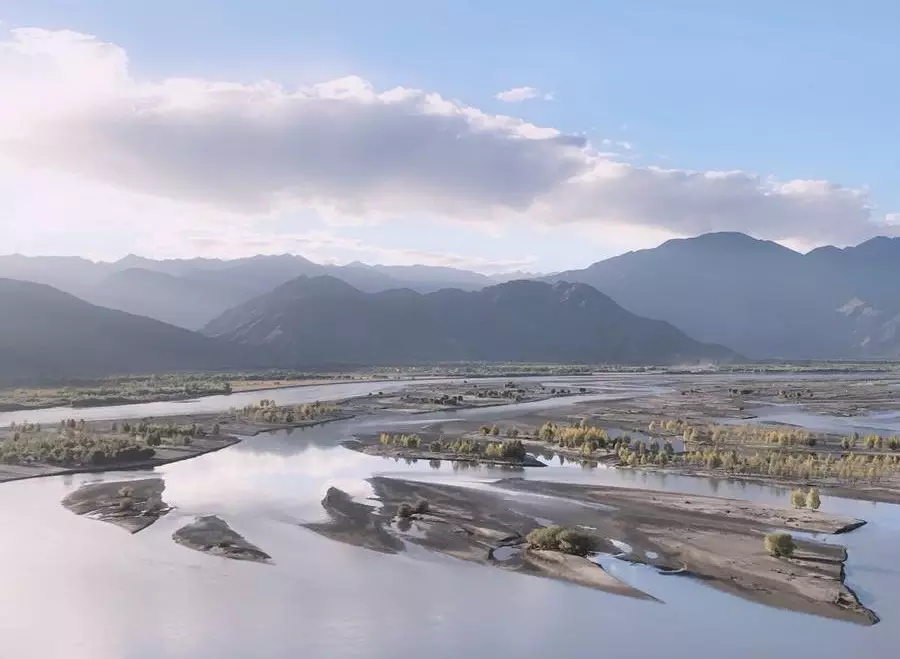
From the top of the monastery, one can overlook the winding Yarlung Tsangpo River below. At dawn, sunlight glimmers on the water’s surface, reflecting distant mountains and forests.
In spring and summer, golden rapeseed flowers bloom along the riverbanks, forming a striking contrast with the crimson robes of monks. In winter, mist rises through the valley, and the monastery appears half-veiled in fog, adding to its quiet mystery.
Here, religion, culture, and nature merge harmoniously, allowing visitors to experience the unique vastness and serenity of the Tibetan plateau.
Email response within 0.5~24 hours.