


Dujiangyan Irrigation System

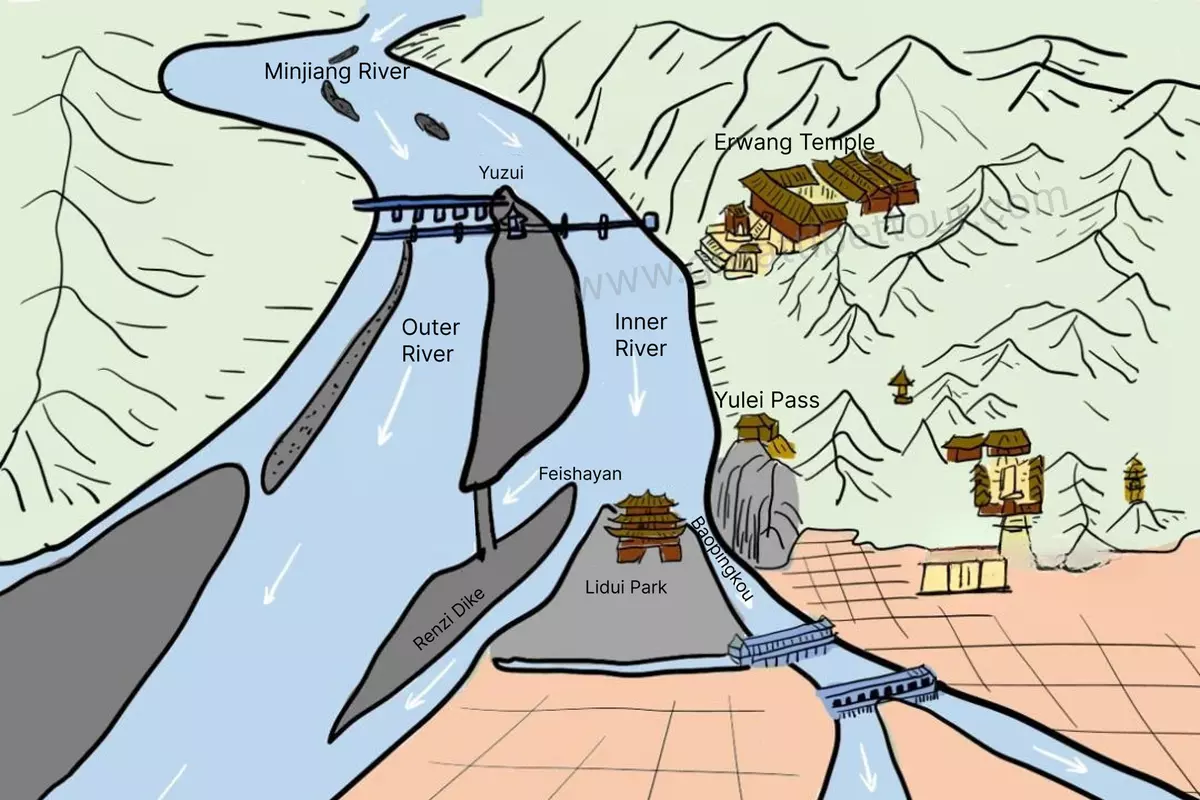
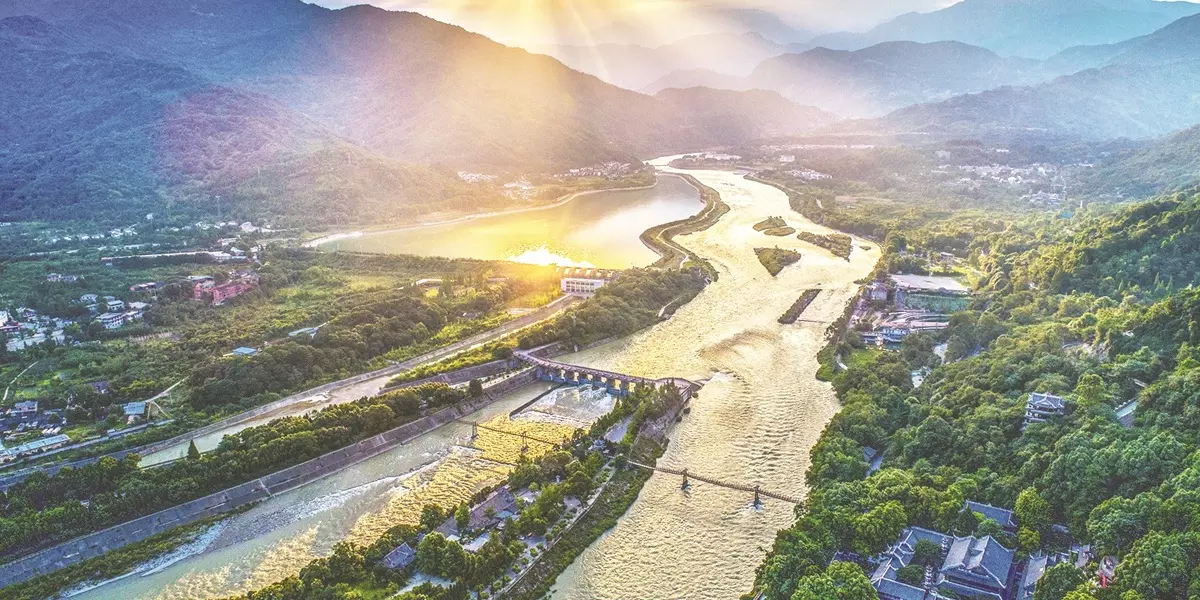
Dujiangyan is the world's oldest dam-free irrigation system still in use today. Designed around the principle of working with the natural flow of water, it makes irrigation possible during dry seasons while safely dispersing floods in times of heavy rain. Even today, the system continues to nourish the Chengdu Plain, Sichuan, China. Standing between the Yuzui (Yuzui Water Dividing Dike), the Feishayan (Feishayan Spillway), and the Baopingkou (Baopingkou Water Inlet), visitors can clearly grasp the ingenuity of this ancient project and understand why the region became known as the “Land of Abundance.”
Surrounded by scenic landscapes and complemented by the Taoist heritage of nearby Mount Qingcheng, the Dujiangyan area represents a rare combination of nature, engineering, and human tradition, and together they form a UNESCO World Cultural Heritage site.
History of the Dujiangyan Irrigation System
More than 2,000 years ago, the Chengdu Plain had fertile land, but it was threatened by floods from the Minjiang River all year round, making people's lives extremely difficult. In 256 BC, Li Bing, the governor of Shu County, came here together with his son and decided to use an unprecedented method to control floods - not to build high dams, but to follow the natural terrain and let the water "find its most suitable path."
At that time, the Minjiang River outlet was "high in the northwest and low in the southeast", so they followed the natural terrain, cutting through the mountain and digging channels so the river water could flow in balance with the land. After the completion of Dujiangyan, it effectively resolved floods and continuously irrigated the Chengdu Plain, freeing the area from floods and doubling its grain production, thus laying the foundation for the "Land of Abundance".
What's even more amazing is that this system is still in daily operation after more than 2,250 years, and it still nourishes the entire western Sichuan region. It is a representative work of ancient Chinese engineering wisdom and the harmonious symbiosis of nature.
Core Structures of the Dujiangyan Water Conservancy System
To understand Dujiangyan, it is essential to see its three core structures: the Yuzui Water Dividing Dike, Feishayan Spillway, and Baopingkou Water Inlet. Together, they explain how this ancient system has irrigated the Chengdu Plain for over two thousand years without dams or reservoirs.
Yuzui Water Dividing Dike: the starting point for precise water distribution
Located at the point where the Minjiang River splits, Yuzui is shaped like a fish head, hence its name. Often called the “water-dividing fish,” it separates the river into two channels: the Inner River for irrigation and the Outer River for flood discharge.
Its design follows the natural flow of the river. During the dry season, more water enters the Inner River to support farming. In flood season, excess water is guided into the Outer River. Standing here, the principle is easy to grasp—water is guided, not blocked.
Feishayan Spillway: a "safety valve" for automatic sand discharge and flood diversion
The Inner River carries not only water but also large amounts of sediment. Feishayan Spillway solves this problem through a slanted opening that automatically releases excess water and silt into the Outer River when levels rise.
By using the natural swirling force of the current, around 75 percent of the sediment is discharged downstream. This allows the Inner River to remain clear, showing an early and effective form of automatic desilting.
Baopingkou Water Inlet: the narrow “bottleneck” leading into the Chengdu Plain
Baopingkou resembles the neck of a bottle, using terrain and hydraulic principles to precisely regulate the volume of water entering the Inner River. It keeps the flow steady, ensuring that irrigation water is neither too much nor too little. Standing above Baopingkou, you can see the current slow down and become calmer—as if it has been naturally balanced.
Highlights of Dujiangyan Scenic Spot
The essence of Dujiangyan lies in its core World Heritage irrigation project and the surrounding cultural landscape. The following four attractions are also worth visiting.
Erwang Temple
Erwang Temple is located high on the right bank of the Minjiang River. It is a core cultural landmark commemorating Li Bing and his son. It is also the first stop for most tourists after entering the scenic spot. The temple area combines traditional palaces and garden landscapes. Ancient water control texts and images are engraved on the stone walls, telling the origin of Dujiangyan. Climbing up to the high platform of the temple, you can have a panoramic view of the overall layout of the project. It is an ideal viewing point to understand the wisdom of the Dujiangyan Irrigation Project.

Anlan Suspension Bridge
The Anlan Suspension Bridge spans the Minjiang River and is one of the most engaging landmarks in Dujiangyan. The entire bridge is mainly made of wooden planks and ropes. When walking on it, it will sway slightly with your footsteps. This is the most direct way for tourists to feel the power of the Minjiang River. Standing in the center of the bridge, you can clearly overlook the overall structure of Dujiangyan, and the division of the inner and outer rivers is clear at a glance.
Yulei Mountain
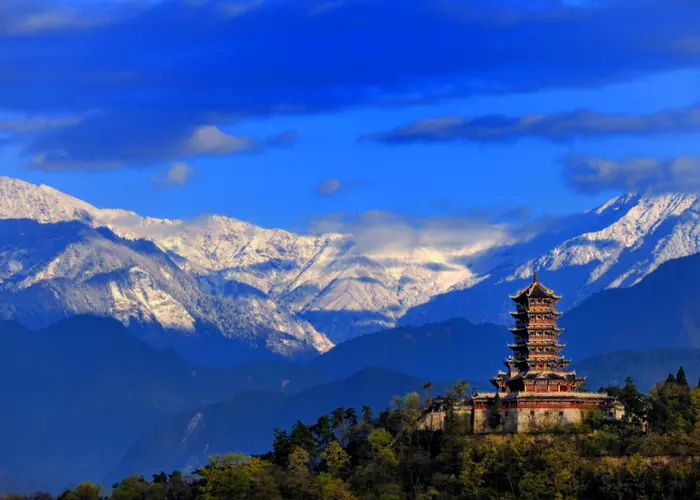
Yulei Mountain is an important vantage point overlooking the panoramic view of Dujiangyan. Walking slowly along the forest trail, you can see ancient trees and the remains of Ming Dynasty city walls, and the environment is quiet and natural. After climbing to the top of the Yulei Pavilion, you can have a panoramic view of the entire Dujiangyan Water Conservancy Project. On a clear day, you can also see the Minjiang River Valley and the Chengdu Plain in the distance, with a broad view. This is very suitable for tourists who want to understand the layout of the project from an overall perspective and take panoramic photos.
Fulong Temple
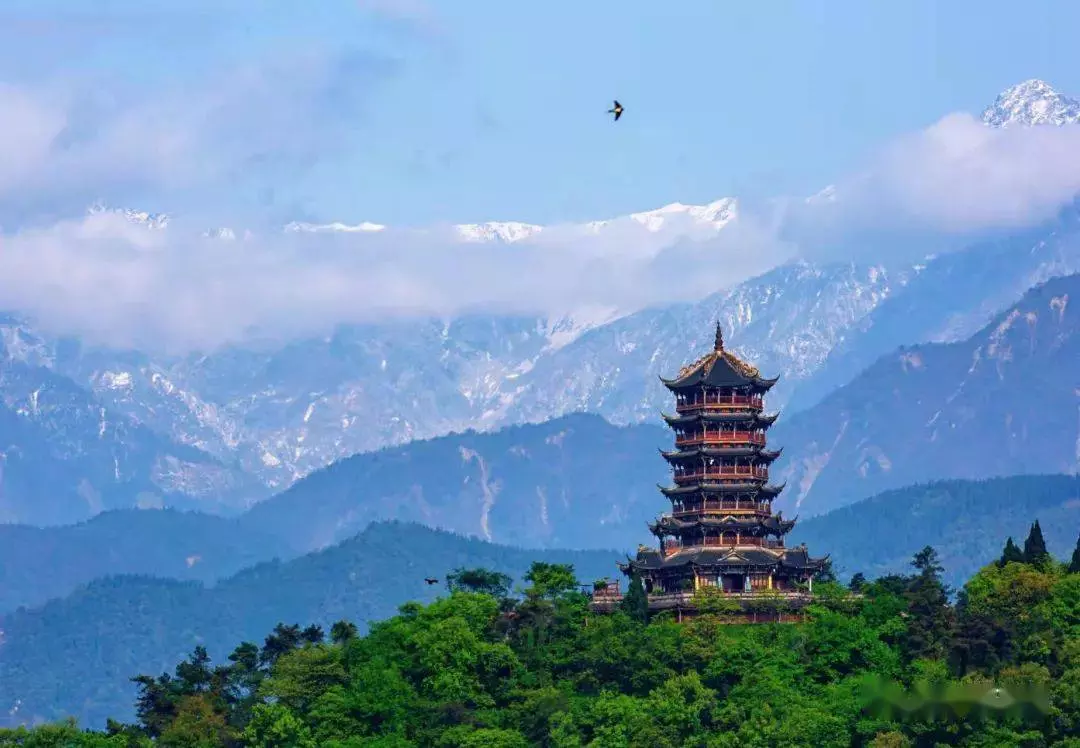
Fulong Temple is surrounded by water on three sides and is full of the legend of Erlang God subduing the dragon. According to legend, the evil dragon was trapped in the deep pool under Lidui, which makes the place even more mysterious. Climbing up high, you can see the Baopingkou and the direction of the river in the distance. It is not only suitable for a short rest, but also suitable for quietly experiencing the cultural atmosphere of Dujiangyan.
Recommended Tour Routes
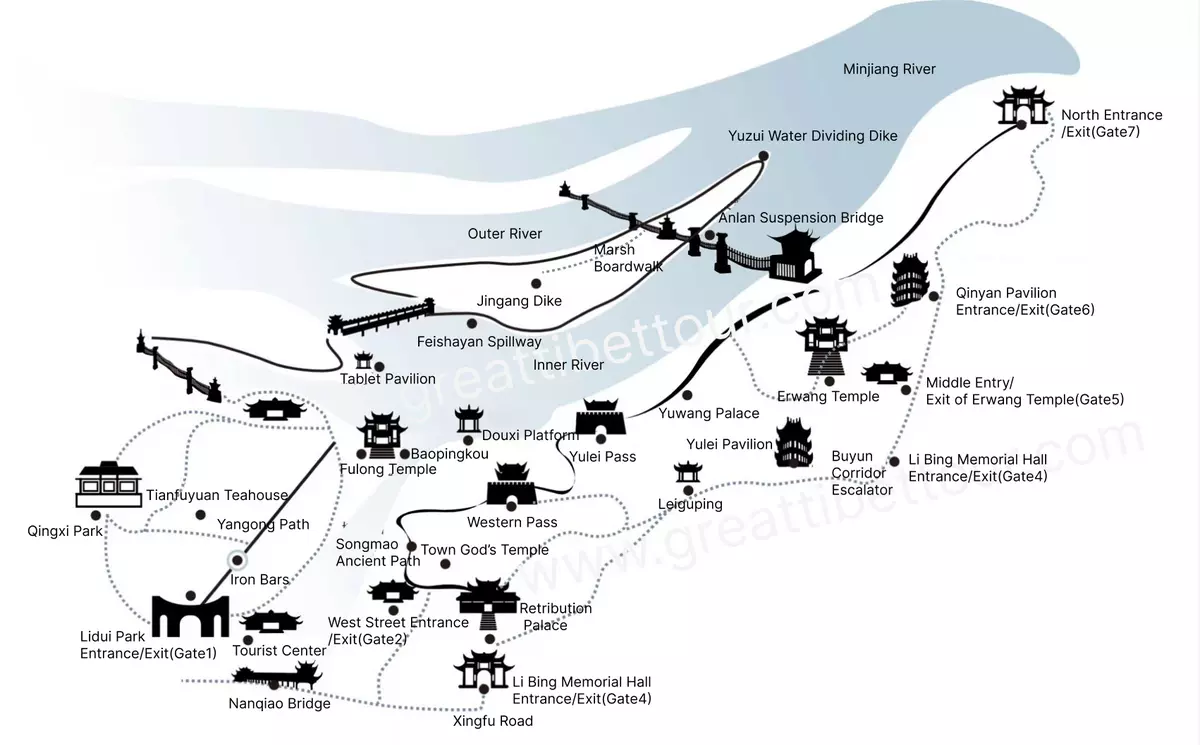
The following three routes are suitable for different needs, helping you feel the wisdom of ancient people in water management and plan your itinerary more efficiently.
Route 1 - Easy Route (2–3 hours)
Enter from Qinyan Pavilion and exit from Lidui Park. It's ideal for the elderly, children or tourists who want to visit easily.
Entrance → Qinyan Pavilion → Erwang Temple → Anlan Suspension Bridge → Baopingkou → Yuzui → Feishayan → Fulong Temple → Yulei Pass → Exit
Route 2 - Classic Loop Route (3–4 hours)
Enter from the main entrance of Lidui Park and exit from the West Gate. It is suitable for tourists who want to have a comprehensive tour.
Lidui Park Main Entrance → Qingxi Park → Fulong Temple → Baopingkou → Feishayan → Yuzui → Anlan Suspension Bridge → Qinyan Pavilion → Erwang Temple → Yulei Pass → Exit via West Gate
Route 3 - One-day route for Dujiangyan Irrigation System and Qingcheng Mountain
In the morning, you can visit the core water conservancy facilities such as Baopingkou, Feishayan, and Yuzui in Dujiangyan, and learn about the overall intelligent system of dam-less water diversion, sand discharge, and flow control in ancient times. In the afternoon, you will head to Qingcheng Mountain. As an important birthplace of Chinese Taoism, the place has green trees and Taoist temples hidden in the mountains, embodying the natural philosophy of "harmony between man and nature". Combining the water control concept of Dujiangyan with the Taoist culture of Qingcheng Mountain, it is a very classic combination route to experience Sichuan's unique culture and natural features in one day.
Best Time to Visit
The best times to visit Dujiangyan are spring and autumn. However, each season offers its own scenery.
- Spring (March-May): The water volume is moderate and the mountains are the most beautiful, making it the most photogenic season of the year.
- Autumn (September-November): The weather is refreshing and transparent, which is very suitable for walking in scenic spots, and the distant mountains and flowing water are particularly clear.
- Summer (June - August): The temperature is higher in summer, while the Minjiang River is at its most spectacular, which is the best time to feel the "power of the Pentium".
- Winter (December to February): There are fewer tourists, which is suitable for those who like to travel quietly, but the temperature is low, so you need to keep warm.
Beyond its natural scenery, Dujiangyan is also known for its distinctive festivals. Around the Qingming Festival at the beginning of April, the ancient Water Release Festival is held, reenacting water-worship rituals that have continued for more than two thousand years, with a solemn and unique atmosphere. In late June, the Li Bing Memorial Ceremony commemorates Li Bing and his son through traditional rites, allowing visitors to experience the deep water-control culture and historical legacy.
How to Get to Dujiangyan
Located about 60 km northwest of downtown Chengdu, Dujiangyan is easy to reach by public transport or private transfer.
Option I - Take Metro Line 2 or Line 6 to Xipu Station, then transfer to the intercity railway to Lidui Park Station or Dujiangyan Station. After getting off, walk or take a taxi for about 1 km to reach the scenic area. The whole journey takes about 50 to 70 minutes and costs 15 yuan.
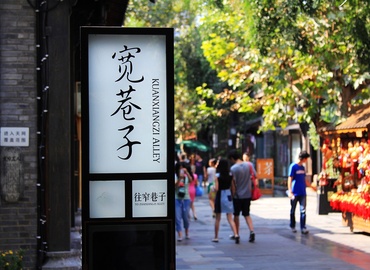
Option II - Take the shuttle bus from multiple hubs in Chengdu, including Chengdu IFS/Taikoo Li Business District (on the B2 floor of Taikoo Li IFS underground parking lot), Kuanzhai Alley (next to the East Square Tourist Information Booth), Xinnanmen Bus Station and Chadianzi Station. The journey takes about 1-2 hours and the ticket fare is about 20 yuan.
Option III - Charter a car hire an online car to go to Dujiangyan. The journey takes about 50-60 minutes; it is suitable for families or tourists with elderly people and children. It takes about 1 hour and costs 200 yuan.
Travel Tips
- It is recommended to wear non-slip shoes as some viewing points are close to the water.
- During the rainy season, there is a lot of water vapor, so it is recommended to bring a waterproof jacket.
- There are many steps in Yulei Mountain, so it is not suitable for tourists with weak physical strength or weak knees.
- The scenic area is large, so it is recommended to plan the route in advance and reserve enough time.
- The best time to take photos of the Anlan Bridge is usually in the morning.
- If you have extra time, you can visit the surrounding attractions: Qingcheng Mountain (Taoist cultural resort, good natural scenery), Panda Valley (less crowds and quieter, easier to take pictures of pandas), Nanqiao Ancient Town (close to Dujiangyan city, most atmospheric for shopping and eating at night).
Let Us Help You Plan Your West China Journey
As a China-based travel agency recommended by Lonely Planet and honored with the Tripadvisor 2025 Travelers’ Choice award, we offer reliable and thoughtful travel experiences across China. Our consultants create tailored itineraries around the Dujiangyan Irrigation System and nearby areas, carefully planning your trip to ensure a smooth and worry-free journey.
Chengdu - Dujiangyan - Leshan - Chengdu
Visit 4 World Heritage Sites, you can experience the combination of natural scenery and cultural landscape.

Email response within 0.5~24 hours.